
All articles6 minute read
Caregiver loneliness, and why being with somebody all day makes it worse
You are almost never on your own, and that is the part nobody warns you about. This is the loneliness of spending every hour with a person who cannot be company.
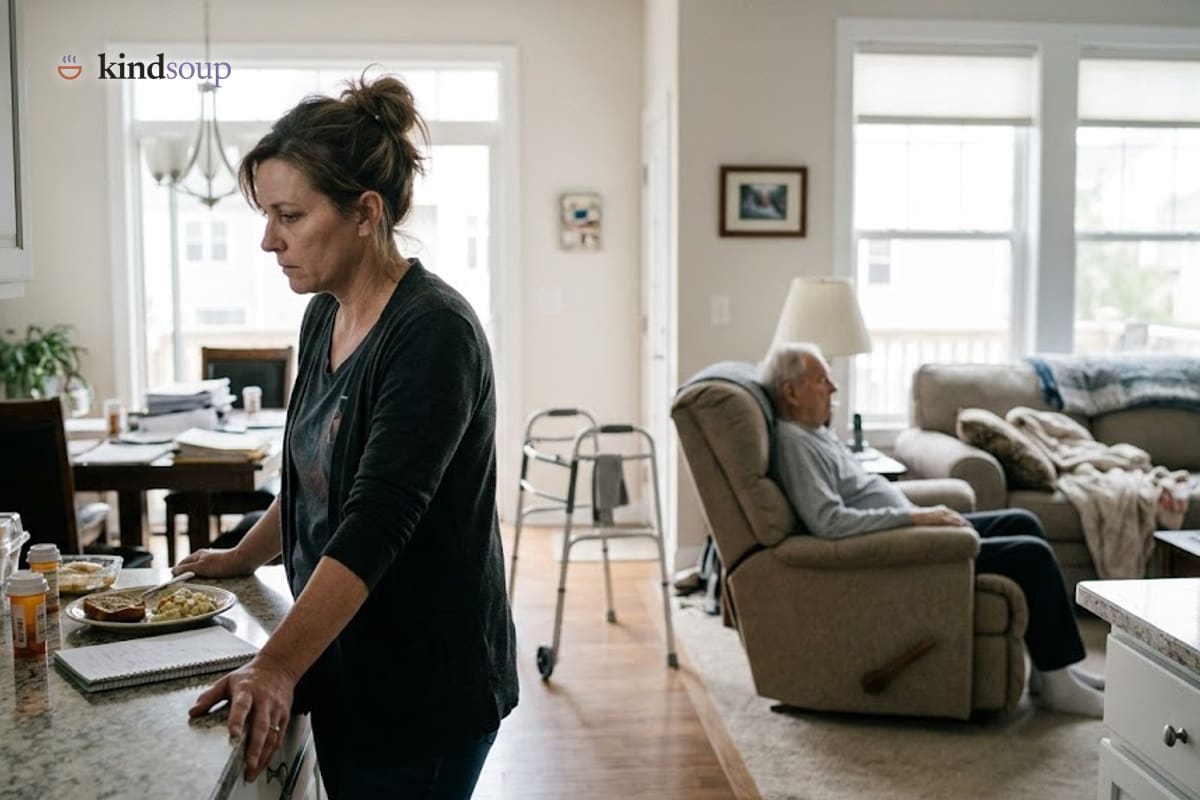
People hear lonely and picture an empty house. Caregivers are hardly ever alone and describe the loneliness as worse for it, which makes it hard to say out loud and easy to feel ashamed of.
Here is what they actually describe, and the few things that are reported to change it.
It is not solitude. It is company that stopped working
The person you would have told about your day is the day.
They are in the next room. You have spoken to them two hundred times since breakfast, about the tablets, the toilet, the weather, the same question four times in an hour. All of it is talking and none of it is conversation.
Caregivers describe going quiet inside a full house. Nothing to say to the one person there, and nobody else there to say it to.
This is also why advice about getting out more lands so badly. The problem is not a shortage of people in the room.
Why your friends stopped calling
Almost never malice. They ran out of questions.
Everybody has the same one, which is how is she, and your answer has not really changed in two years. They hear it, they feel useless, the gap until the next call gets a little longer, and eventually the length of the gap is itself the reason not to call.
The other half of it is yours and is harder to admit. You said no to enough things that people stopped asking, which is the rational response to somebody who always says no and still arrives like a door closing.
Caregivers describe the moment they notice as specific and quite late: scrolling a group photo from something they were not told about.
You stopped being somebody with news
Small talk needs a life with events in it. What have you been up to has no safe answer when the honest one is a catheter and a phone call with the insurer.
So people say not much, and the conversation closes there, and they go home lonelier than before they went out. Say the true answer instead and you watch the other person’s face change, and then spend the drive home regretting it.
Both roads end in the same place, which is why people stop taking either.
The three in the morning version
The hours when everybody who loves you is asleep, and the one person awake in the house is the person you are looking after.
Caregivers describe sitting with a phone they cannot use, scrolling because there is nothing to scroll for, aware that any message sent now is a message somebody wakes up to and worries about.
This is the hour most described as unbearable, and the one with the fewest options in it.
What people say actually helped
Other caregivers, and the reason given is almost never support. It is not having to explain the backstory. You can start a sentence in the middle and nobody needs the diagnosis, the timeline or who the difficult sibling is.
Something you can answer at odd hours rather than something scheduled. A standing Thursday at seven is a promise most caregivers cannot make, and failing it twice is worse than never having it.
Typing rather than talking. A phone call needs a stretch where nobody is calling for you. A message does not, which is why text threads survive in this life and phone calls do not.
And one person who asks about something that is not the patient.
Ask one person to ask you something else
This is the most concrete thing on the page, and people describe it working the first time.
Pick the friend most likely to take it well, and say a version of: I am going to tell you how she is, and then I would like you to ask me about something that is not her.
It gives them the thing they were missing, which was never willingness. It was a second question. Most people are relieved to be handed one.
Several caregivers describe the same friend becoming their main contact afterwards, for years, on the strength of one awkward sentence.
Missing your own life is not resenting theirs
The shame around this is the part that keeps people quiet, and it rests on a confusion worth naming.
Wanting somebody to ask how you are is not a complaint about the person you are looking after. Being lonely in a house with somebody in it is not ingratitude, and it is not a sign that you love them less than you should.
It is what happens when every relationship you had got slowly replaced by one relationship, and that one changed into something that cannot give back.
The thing most often described as helping is not a group, a hobby or a better attitude.
It is one person who already knows the backstory, so you can start a sentence in the middle.
Everything here is what worked for people doing this at home. It is not medical advice, and Kind Soup is not a medical or emergency service. If somebody is in danger, contact your local emergency number.
Also on Kind Soup
- Why won’t mom shower?Not the clinical answer. What actually worked for people who fought this every week for years.
- Sundowning: what actually helps at four in the afternoonShe is fine all day. Around four it starts. Here is what caregivers do about the hardest two hours of the day.